At Henris Roofing, we’ve installed and maintained these systems throughout our more than 80 years in business, and we continue to rely on the fundamentals that make this approach so durable.
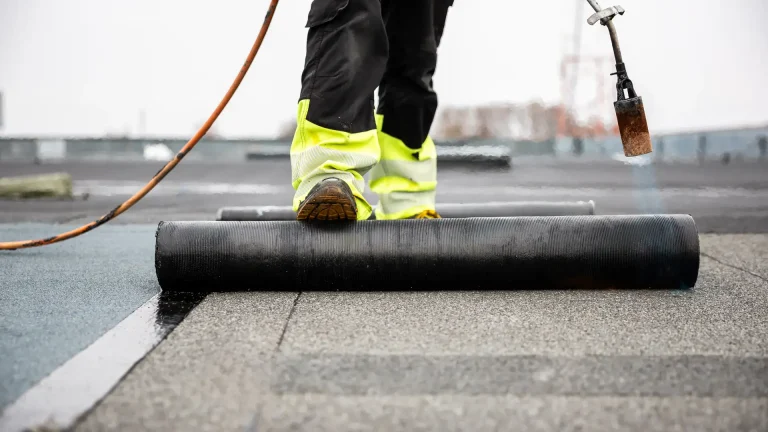
Hot asphalt roofing, often called built-up roofing or BUR, works by layering alternating plies of reinforcing felt or fiberglass matting with mopped-on hot asphalt bitumen. When the asphalt is heated to its exact application temperature and applied between each ply, it fuses the layers into a single monolithic membrane. The result is a thick, redundant barrier that can withstand ponding water, foot traffic, and temperature swings far better than many single-layer alternatives.
The Application Process We Follow
Every hot asphalt installation begins long before the kettle is fired up. We start by inspecting and preparing the deck, ensuring the surface is dry, sound, and free of contaminants that could interrupt adhesion. Any damaged decking is repaired, and we install a base sheet mechanically fastened or set into asphalt to create a stable foundation for the plies above.
The hot asphalt itself is heated in a specialized kettle to a controlled temperature, typically between 400 and 500 degrees Fahrenheit depending on the asphalt grade. Precise temperature control is critical. Too cool, and the bitumen won’t flow or bond properly. Too hot, and it degrades, losing its waterproofing properties. Our crews monitor these temperatures carefully throughout the day.
- Deck preparation: cleaning, drying, and repairing the substrate before any material is applied
- Base sheet installation: anchoring the first layer to create a uniform surface
- Ply application: mopping hot asphalt and embedding successive reinforcing felts
- Surfacing: finishing with gravel, mineral cap sheets, or a reflective coating for UV protection
Because we respect your property and are mindful to clean up after ourselves, we contain the work area, manage the kettle safely, and remove all debris when the project is complete. We also offer free estimates with no conditions, so you can understand the full scope before committing.
Technical Specifications and Material Choices
The performance of a hot asphalt roof depends heavily on the specifications selected for your building. A standard three-ply or four-ply system offers escalating levels of redundancy, meaning that even if one layer is compromised, the layers beneath continue to protect the structure. We match ply count and asphalt grade to your building’s slope, climate exposure, and expected traffic.
Surfacing options carry their own technical considerations. Gravel-surfaced roofs provide excellent protection against UV degradation and impact, while smooth-surfaced systems with reflective coatings can reduce cooling loads on the building below. As an Energy Solar Certified contractor, we’re happy to discuss how reflective surfacing and complementary technologies contribute to a building’s overall energy efficiency, and we approach every project with environmentally friendly best practices and materials.
Our credentials speak to the standards we hold ourselves to. Henris Roofing is a GAF Master Elite contractor, holds ShingleMaster Pro certification, and is recognized as a Timberline Solar Roofing Contractor. While some of these recognitions center on steep-slope work, the same commitment to training, quality, and manufacturer-approved installation carries directly into our hot asphalt projects.
Where Hot Asphalt Roofing Fits Best
Hot asphalt roofing serves a wide range of buildings across Petaluma, CA and surrounding areas. Commercial properties such as retail centers, office buildings, and manufacturing facilities benefit from the system’s durability and its ability to handle rooftop equipment like HVAC units and vents. Multi-family residential buildings, schools, hospitals, and municipal structures also rely on built-up roofing for its long, dependable service life.
These systems excel wherever a flat or low-slope deck needs proven, redundant waterproofing. Because the membrane is seamless across its entire surface, it handles ponding water and thermal movement gracefully, which is why it remains a preferred choice for property managers overseeing large square footage.
- Commercial and industrial: warehouses, storefronts, and factories with expansive flat roofs
- Institutional buildings: schools, healthcare facilities, and government structures
- Multi-family housing: apartment and condominium complexes needing durable coverage
As a professional, reliable, and established company that supports our local community, we provide full-service roofing solutions for both residential and commercial clients, backed by 24/7 emergency service whenever an urgent problem arises. When you’re ready to explore hot asphalt roofing, Henris Roofing is prepared to help you protect your investment for decades to come.